

Marketing Strategy
Review of Marketing Plan
Annie’s Homegrown is in the dry-packaged and convenience foods industry. These products are designed to be produced quickly and consumed easily. These products typically consist of such side dishes/foods as macaroni and cheese, flavored noodles, and rice mixes. According to a study, 60% of Americans purchase dry macaroni, 46% purchase dry rice mix with seasoning, and 45% purchase dry pasta-based meal/side dishes. This comes out to roughly 191,340,000 / 146,694,000 / 143,505,000 respectively (Mintel, 2014). The majority of the competition in this sector comes from Kraft and Knorr products. In 2014, the dry macaroni and cheese market was forecasted to have $1.3 billion in sales (Mintel, 2014).
The overall category of dry macaroni and mix slipped 1% in sales to $1,180,200,576, but sales grew for Annie’s in October of 2015. Regardless sales rose 13%, to reach $101,400,256 in 2016, and while their dollar market share increased a percentage point to 8.6% (Gelski, 2016). Over the past several years there has been an increasing trend in the popularity of organic foods and healthy alternatives in the minds of consumers here in the U.S. As a result, products containing high trans-fat content are losing market share to low calorie, low fat, natural and organic goods (Gelski, 2016). The U.S. organic food market grew by 11% in 2014 to reach a value of $35,891.9 million (Marketline, 2016). By 2019, this market is expected to be worth $61,119.3 million, representing an increase of 70.3% since 2014 (Marketline, 2016).
Due to the rising health trend in America, Kraft is losing both market share and popularity. The International Food Information Council Foundation’s 2016 Food and Health Survey asked participants what they considered the top reason for avoiding or limiting packaged foods. The top answer, given by 32% of respondents, was because they contain artificial ingredients or preservatives (Gelski, 2016). From our research we found that 82% of consumers are more likely to purchase a product that represents Corporate Social Responsibility than one that does not (SolarCity, 2016). The global gluten-free packaged food market is projected to grow at a compound annual growth rate of approximately 6% between 2015 and 2019, according to a report from Technavio (Watrous, 2016). These statistics stand to represent the opportunity Annie’s has to capitalize on market shares in a moving industry.
Company Snapshot
In 1989, Annie’s Homegrown, Inc. was founded by Annie Withey and Andrew Martin with the ultimate goal of creating a healthy and delicious macaroni and cheese tailored towards families. Annie Withey was quoted in 2004 saying that “twenty-five years after the company’s founding, our original values still guide our business.” In 2014 Annie’s was acquired by General Mills for $820 million. Most recently, their mission is to “cultivate a healthier and happier world by spreading goodness through nourishing foods, honest words and conduct that is considerate and forever kind to the planet” (Annie’s Homegrown, 2016).
Revenue in Millions for Annie's Homegrown
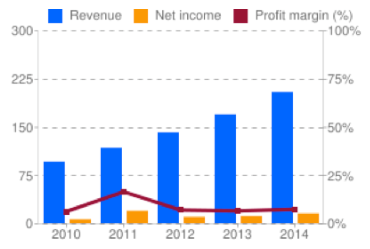
*Pulled from Google Finance
The focus of our campaign is centered around Annie’s brand under General Mills, specifically their pasta product line, and more specifically their macaroni and cheese. This company is currently publically traded and had an IPO of $100 million. Their sales ending the fiscal year 2014 were $204,104,000. (Hoovers, 2016) The market share of this company is a bit smaller due to its higher prices and fewer number of target markets. Some of the strengths include the use of non-GMO ingredients in its variety of different products and using recyclable materials for their packaging helping promote a positive brand image. Annie’s places a lot of importance on their corporate social responsibility placing “Box Tops” on each package as well as child and scholarship programs.
Through our research, we found that nearly 3 in 5 Millennials indicated that they had purchased an organic food or drink in the last three months. Along with this, the purchase rates seemed to drop dramatically among the Baby Boomer and older generations alike. In 2015, it was reported that roughly 24% of Millennials said that organic products comprise at least three quarters of their total food/beverage purchases (Roberts, 2015). It comes with no surprise then that their target markets are health conscious young adults/college students and health conscious families/parents.
Organic products make up a $48 billion dollar industry. In 2015, the organic industry was predicted to increase to a $211 billion dollar industry by 2021 (“U.S. Organic food industry - statistics & facts,” 2015). With parents growing more concerned about their children’s health, more families are choosing the organic option over other alternatives (Lam, 2016). By targeting this market, the campaign will position Annie’s products as a premium, nutritious alternative compared to unhealthier brands such as Kraft and Velveeta. Annie's will work to inform our customers that they can get the same foods that they enjoy or that their children enjoy, in an organic option. We’ll position ourselves as the superior choice to our direct competitors by highlighting on the organic elements while also highlighting that Annie’s is less expensive than Kraft (which will be a huge selling point for price sensitive students). We’ll also highlight the fact that Annie’s has a microwavable version of their product as well, which is ready in only two minutes.
SWOT Analysis
Strengths:
- Product Quality
- Natural
- Organic
- GMO-Free
- Growth of healthy food consumption
- Positive brand image
- Brand loyalty
Weaknesses:
- Low brand awareness
- Higher priced products compared to comparison
- No significant advertising campaigns
Opportunities:
- Increasing popularity of organic foods and healthy
alternatives in the United States
- Gain market share from Kraft as they are slow to
adapt
- Key competitors do not have a brand image that connects with health conscious individuals
- Capitalize by using General Mills supply chain relationships
Threats:
- Higher competitor brand awareness
- Increased competition of organic products
- Lower priced alternatives
